
Wednesday, November 24, 2010
Floating Theories
0 comments“Reference is to your April 20th memorandum asking certain questions regarding to this country’s space program,” Lyndon B. Johnson’s opening line in his memorandum written for John F. Kennedy entitled “Evaluation of Space Program”. Provoked by Cold War competition with the Soviet Union, President John F. Kennedy issued a historic challenge in a speech to Congress given May 25, 1961: “I believe that this Nation should commit itself to achieving the goal, before this decade is out, of landing a man on the moon and returning him safely to earth.” In response, NASA initiated Project Apollo which carried the sole purpose of man’s conquest of the moon. Eight years, about twenty missions, and billions of dollars later, Apollo 11 launched to fulfill Kennedy’s challenge. The world tuned in July 20th, 1969 transfixed as the sole of Neil Armstrong’s spacesuit imprinted the first human steps on the moon after Armstrong descended from the lunar module, declaring, “That’s one small step for man, one giant leap for mankind.” Skeptics arose with the lunar dust.
Bill Kaysing, author of We Never Went to the Moon: America’s Thirty Billion Dollar Swindle, is the sole spark which caused the moon hoax movement. His book lead to different moon landing conspiracy theories that add to the claim that some or all elements of Project Apollo and the associated moon landings were falsifications staged by NASA and members of other government organizations. These accusations were delicately illustrated in Kaysing’s publishing in 1974. The entire movement was based on his original arguments that are either biased or can be easily disproven. In the circumstances in which Kaysing’s self-published his book, given his educational and career background, and given the content published: government scandals, billions of dollars spent, NASA’s confidential information, and the lies portrayed in the media, the book exploded and his ideas spread. But, is there a possibility that this all could have been an ingenious work of fiction released during a time of opportunity?
The time of the release was post-Watergate when distrust in the government grew in popularity. The burglary and attempt at a cover-up lead to the possible impeachment of Richard M. Nixon and subsequent resignation. The scandal included political burglary, bribery, extortion, phone-tapping, conspiracy, and obstruction of justice, destruction of evidence, tax fraud, illegal use of government agencies such as the CIA and the FBI, illegal campaign contributions, and use of public money for private purposes. Coverage of this event was multifaceted. Every sort of media plastered Richard M. Nixon on the front page or top story. Nixon denied the allegations and went further by televising an address to the nation explaining why the release of the Water-gate tape transcripts will be edited. General reactions were of distrust when 18 and a half minutes were absent from the transcripts based on the presidential power of executive privilege.
The subject of confidential NASA information is a subject that tends to keep books moving off the shelves as well as the subject of government scandal. Regan recently opened the market for public outcries and speaking against the U.S. government. The Water-gate scandal gave the book some emotional and logical appeal to suggest that it is possible that a government cover-up could have taken place during Kennedy’s term and all throughout the Apollo missions. Kaysing sold his argument by involving the money of the audience, taxpaying Americans. Billions of dollars went towards research and development of new technologies that remained classified due to the rivalry with the Soviet Union. Kaysing claimed that this money was spent bribing the film crew hired to capture “man’s first steps on the moon” and the placement of the American flag. The idea that the government would use the taxpayer’s money to fake the greatest achievement known to mankind and distribute “hush money” accordingly is the type of charged controversy with which Kaysing sold his theory.
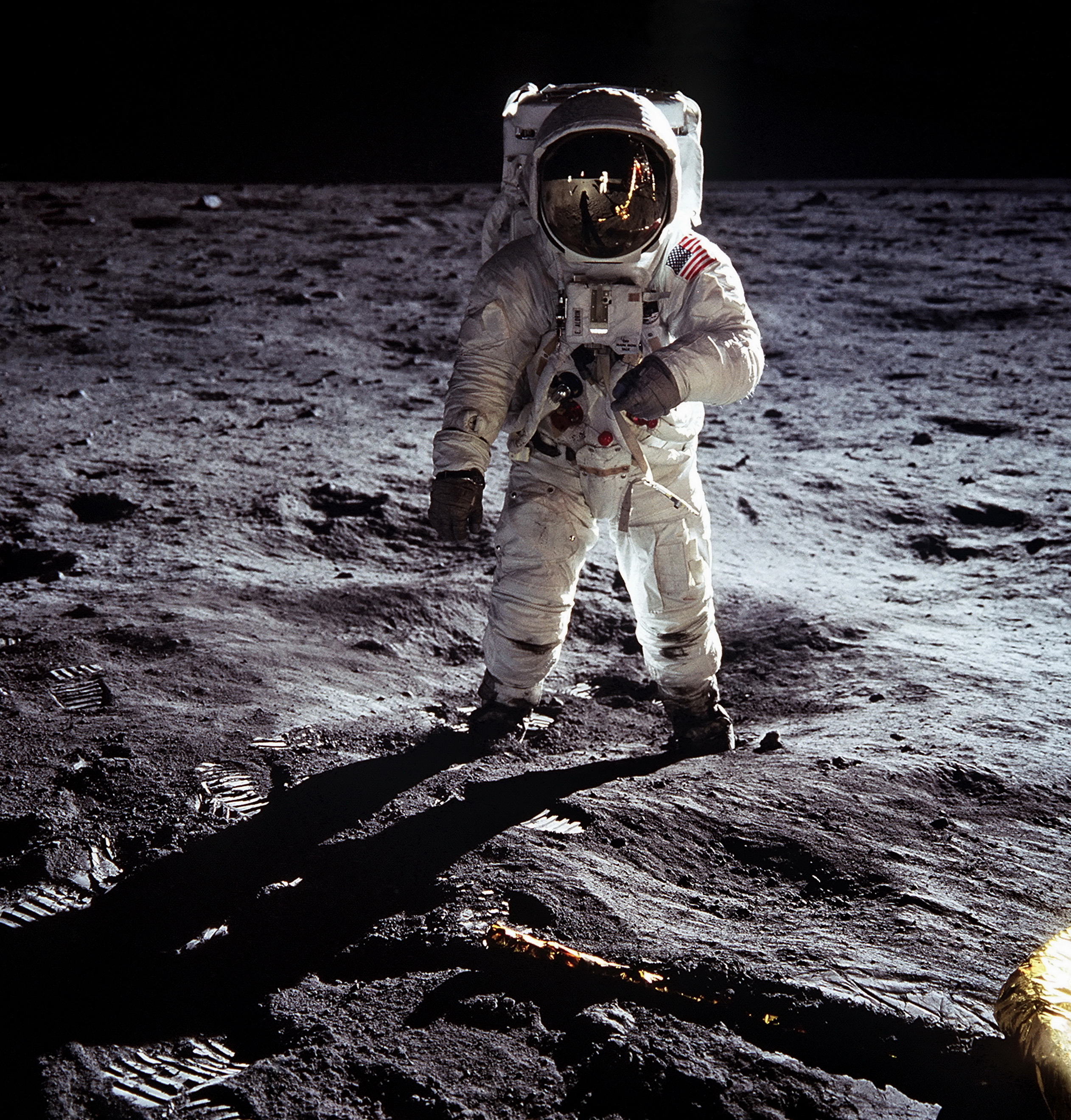
The original basis of much of the hoax theory was the apparent inconsistencies in official photos, film and other records. Kaysing relied heavily on visual images to create impact. For example, photos of converging shadows, which leads to the idea that there was a possibility of two light sources and proof the photos were falsified in a studio, were easy to see and appeared to be black-and-white evidence: the camera never lies. In the years since then, the original photographic anomalies have all been correctly explained to the extent that they are beyond argument. The "converging shadows" phenomena, for example, has been proven on Myth Busters to have a possible second, more probable explanation in which the immediate topography of the area caused the shadows cast on sloping surfaces to appear to have a second light source.("Mythbusters Moon flag waving hoax"). Kaysing’s argument that the absence of stars in pictures taken by Buzz Aldrin on Apollo 11 can disproved with simple photographic knowledge. The picture is composed in a way that the lunar surface covers the foreground of the picture with the Earth in displaced in a black abyss. The barren gray surface is highly reflective as well as the illuminated portion of the Earth and would call for a shorter exposure than stars in the background leaving the diamonds in the sky to be drowned out by the intensely bright surface. Arguments about the illumination of the astronauts and the shadow side of the rocks which appears completely black can be disproven with knowledge of the reflective qualities of the lunar surface and the amount of area shadows cover when assessing the foreground lighting of the photographs. At the elevation of the astronaut's feet, and the foreground rocks, this reflector surface is mostly covered by the adjacent shadows. While the shadows cast by the torsos and heads of the astronauts the shadows cover a much smaller percentage of the surface ("Moon Hoax Debate"). The combinations of these circumstances lead to the confirmation that lighting of the Apollo 11 mission photos are realistic and could be achieved in such an environment.
The America’s Thirty Dollar Swindle included points such as the idea that NASA lacked the technical expertise to put a man on the moon. Kaysing failed to address other space programs in its attempt to defraud the moon landing. The Gemini missions were never questioned. These missions, numbered 3,5,6a,7,8,11,and 12, were a series of experiments in which astronauts would test human endurance as well as human ability to control his craft. This includes Gemini 8, in which Neil Armstrong achieved the first docking between two space craft, and Gemini 12, in which Buzz Aldrin spent over five hours performing productive tasks outside the spacecraft. Kaysing also included that the film used by astronauts on the moon should have melted due to the supposed high levels of radiation. He also tried to show that the undulating flags seen in video clips seem incompatible with a vacuum which was also disproven on Mythbusters.
The question remainz, did Kaysing write America’s Thirty Dollar Swindle as a legitimate attack towards NASA and the U.S. Government or were they simply bystanders of his most ingenious writing of his career? He attended the University of Redlands and graduated with a Bachelor’s degree in English Literature. After struggling for a few years Kaysing began working at Rocketdyne's jet propulsion laboratory as a technical writer and later as head of publications in the 1950’s. The job’s responsibilities included interpreting technical data regarding liquid rocket propellants and translating the information into layman's language attempting to procure more government funding for further research. While at this job, Kaysing witnessed closed door rocket testing in which several of these tests resulted in nuclear meltdowns (“Bill Kaysing Tribute Website”). This job provided Kaysing with the proper foundation for writing his book. The years translating would help his ability to reach a wide audience for America’s Thirty Billion Dollar Swindle since he could relay the complex ideas and terminology to something readable by a majority of America. His ideas precipitated after years of collecting and observing information at his job but became focused when Kennedy challenged the country and commenced the Apollo missions. From his experience at Rocketdyne’s, Kaysing determined that the rocket technology did not exist at the time of Apollo 11 even though he had worked there over a decade previous to the lunar landing, before more intensified research and development took place during Kennedy’s seat of presidency. The possibility that the refinement of rocket technology did not meet the capabilities of what they required to effectively control the landing and re-docking of the lunar module became a point of focus for Kaysing even though he had been detached from the industry and its further advancements.
The timing of the release along with the unreliable evidence presented in the book leads me to believe that Kaysing’s theory, however real it may seem to him, spread anti-government propaganda which became widely believed. He had been developing his theory since the time he heard Kennedy announced the race to the moon. Kaysing must have seen an opportune moment after the Water-gate scandal and decided to organize his ideas in a well written, compelling argument in order to capitalize on the popular anti-government sentiment. With Kaysing’s luck, Capricorn One, a movie released in 1978, showed that special effects were effective enough to simulate lunar movement and the environment. This movie was added to the argument after its release in a post-Vietnam environment. This resulted in a resurgence of the moon hoax movement once again in an even more anti-government era. This resurgence was one of many for the continuing moon hoax movement which stirs up the news-streams from time to time. People tend to flock towards conspiracies in times of insecurity. Kaysing took advantage of the manipulated audience simply looking for an answer to their problems.
“Much of this expanding literature suggests that conspiracy theories provide clarity of vision and clear targets for addressing the confusions, frustrations, and insecurities of living in contemporary societies which are characterized by rapid social change; a multiplicity of voices and interests; multi-level, multi-polar balances of power where those at higher levels maintain control through secrecy and controlling information; [and] declining individual autonomy.” (Stempel)

Works Cited.
0 comments"A brief biography of Bill Kaysing ." Bill Kaysing Tribute Website. Breezy News Media, 21/10/10. Web. 24 Nov 2010. <http://www.billkaysing.com/biography.php>.
Johnson, Lyndon B. United States. Evaluation of Space Program. , 1961. Print.
"Mythbusters Moon flag waving hoax." Youtube. Web. 24 Nov 2010. <http://www.youtube.com/watch?v=hMBCfuKs9i8>.
The Moon Hoax Debate. Did We Land on the Moon?, 10/19/10. Web. 24 Nov 2010. <http://www.braeunig.us/space/hoax.htm>.
Stempel, Charles. "Media Use, Social Structure, and Belief in 9/11 conspiricies." J&MC. 84.2 (2007): Print. <http://www.aejmc.org/_scholarship/research_use/jmcq/07sum/stempel_text.pdf>.
Monday, November 15, 2010
Subscribe to:
Posts (Atom)